For many years, working with DNA in the laboratory was much like searching for a needle in a haystack. Whether researchers were trying to verify cell identity, examine genetic characteristics, or detect traces of contamination, the amount of biological material in a sample was often so small that conventional analytical instruments simply could not detect it. Obtaining enough material for reliable analysis could take days or even weeks of painstaking work, with no guarantee of success.

This barrier was finally overcome with the development of the polymerase chain reaction, better known as PCR.
Instead of struggling to analyse minute quantities of DNA, PCR acts as a targeted molecular multiplier. It harnesses the same enzymatic processes that occur naturally in every living cell during division. Within just a few hours, it can turn a single, invisible DNA fragment into billions of identical copies of a precisely selected sequence. What begins as a microscopic trace becomes a strong, easily measurable signal that can be clearly detected and analysed.
Four Essential Ingredients for DNA Amplification
The process of making multiple copies of DNA, known scientifically as amplification, requires no mechanical intervention. Instead, it relies entirely on a carefully prepared biochemical mixture and precisely timed temperature changes.
To successfully amplify a selected region of DNA, the reaction needs four essential components:
- Template DNA (the plan): The original DNA sample containing the specific sequence of genetic information we want to read or investigate.
- Primers (the molecular markers): Short DNA fragments designed to bind precisely to the beginning and end of the target segment. They guide the enzymes, indicating exactly where copying should begin and end.
- Nucleotides (the building blocks): The fundamental components of DNA. Each nucleotide contains one of four nitrogenous bases (A, T, C, G), which act as the individual letters of the genetic code. These building blocks are assembled piece by piece to create a new DNA copy.
- Taq polymerase (the molecular builder): An enzyme that uses free nucleotides as building material and template DNA as a guide to construct a new strand. It was first discovered in microorganisms living in hot springs, which explains its natural resistance to the high temperatures involved in the PCR cycle.
Once these four components are combined, the process itself can begin.
Unwind, Mark, and Build: The Three Stages of a Single Reaction
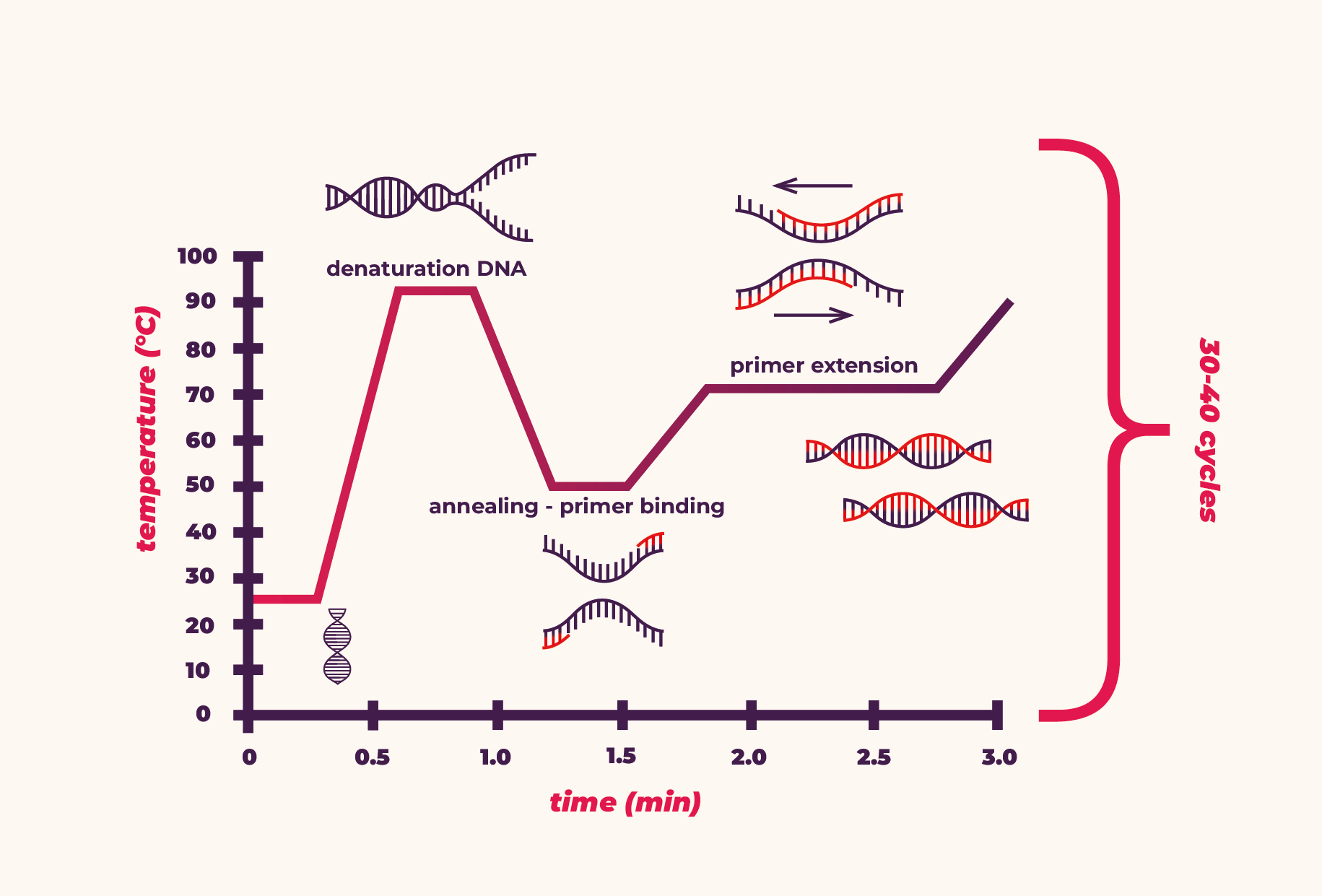
PCR takes place inside a device called a thermal cycler. Using the prepared mixture of our four essential components, the instrument repeatedly carries out a precisely controlled reaction cycle consisting of three steps:
1. Unwinding the Strands (Denaturation)
The process begins by heating the mixture to 95°C. The high temperature breaks the bonds holding the two DNA strands together. The double helix separates into two individual strands, making the genetic template fully accessible for further reading and synthesis.
2. Marking the Target (Primer Annealing)
The temperature is then lowered to a value specific to the primer pair being used, typically 55–60°C. This allows the primers to bind to their complementary target sequences, much like two perfectly matching puzzle pieces. This precisely defines the region of interest, preventing other areas from being amplified. Those regions remain untouched.
3. Building the New Strand (Elongation or Extension)
At the optimal temperature of 72°C, Taq polymerase begins synthesising a new DNA strand. The enzyme attaches to the primers and starts adding free nucleotides, matching each one with its corresponding complementary base. In doing so, it builds a complete new DNA strand.
With every completed cycle, the amount of target DNA doubles. One copy becomes two, two become four, and four become eight. Thanks to this exponential growth, after 30 cycles, the reaction can generate more than a billion copies from a single original DNA molecule. The thermal cycler completes the entire process in approximately two hours, producing enough material for immediate analysis. For our research, this has one major advantage: we no longer have to wait weeks for culture-based tests. If even the slightest trace of foreign DNA or an irregularity appears in a bioreactor or cell culture, these three steps allow us to detect it reliably, almost in real time.
The Technique That Transformed Modern Science
The greatest strength of PCR lies in its specificity. It allows scientists to select and amplify only the DNA sequence they want to investigate, even within a complex biological sample, without interference from the surrounding material.
This unique capability has made PCR a universal standard across scientific disciplines. It helps medical professionals diagnose infectious diseases and genetic predispositions at an early stage, enables forensic geneticists to identify biological traces collected from crime scenes, and provides biotechnologists with a precise tool for analysing organisms. By transforming tiny amounts of biological material into robust, reliable data, PCR gives modern science the information it needs to work effectively.
At BeneMeat, PCR is a cornerstone of our confidence in analytical results. We use it not only to verify the integrity and stability of our cell cultures, but also as a rigorous means of ensuring 100% purity throughout the cultivation process.
It demonstrates how even a seemingly simple molecular principle can hold the key to a safe and sustainable future for food production.